Showing posts with label Classics. Show all posts

Feb 5, 2011

Novels in Florence #26: Incognita


This is the only available edition of a brilliant novel by the leading Restoration dramatist and author of The Way of the World.
Masked balls, mistaken identity, and fanciful deceits run riot in this hilarious tale of love and intrigue by the master of the Restoration comedy.
Returning to Florence on the occasion of his eighteenth birthday, Aurelian - together with his sworn companion Hippolito - dons his disguise in anticipation of the famous Florentine ball. Once there, the two are soon separated, and each finds himself paired off with a beautiful - and masked - woman.
Whilst Aurelian yearns to learn the true identity of his 'love', Hippolito is mistaken for another and brazenly plays along with the conceit. Chaos abounds as masks are dropped, truth revealed, and, somehow, all ends happily. (from jacket notes - Hesperus Press)
William Congreve (1670-1729), the most celebrated of the Restoration comedy writers, was the son of an English officer living in Ireland, and was educated at Trinity, Dublin. His first play, The Old Bachelor, written at the age of twenty-three, was a great success. The Double Dealer, following almost immediately, brought forth the praise of Dryden, the autocrat of English letters. At the age of twenty-seven Congreve had gained a prestige scarcely less in importance than that of Dryden himself. Not only as a comic wit, but as a writer of noble tragedy was he esteemed.
In his praise it should be said that, for almost the first time in England, he brought to the service of the stage a painstaking art. He cared much about the way a sentence was built, about balance, and getting the right shade of meaning. His diction is exactly fitted for oral use; and his pictures of the world of wealth and fashion are diverting. Congreve is, perhaps, the only English writer who can really be compared with Molière.
Incognita, William Congreve, Hesperus Classics, 2003

Jan 7, 2011

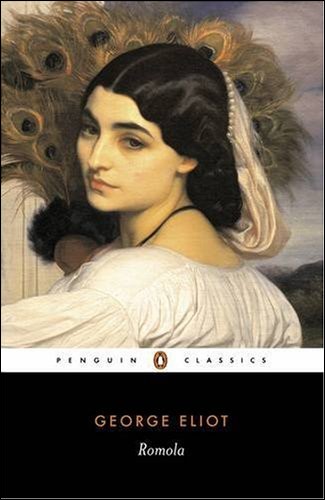
Novels in Florence #21: Romola


One of George Eliot's most ambitious and imaginative novels, Romola is set in Renaissance Florence during the turbulent years following the expulsion of the powerful Medici family during which the zealous religious reformer Savonarola rose to control the city.
At its heart is Romola, the devoted daughter of a blind scholar, married to the clever but ultimately treacherous Tito whose duplicity in both love and politics threatens to destroy everything she values, and she must break away to find her own path in life.
Described by Eliot as written with my best blood', the story of Romola's intellectual and spiritual awakening is a compelling portrayal of a Utopian heroine, played out against a turbulent historical backdrop.
George Eliot (1819-1880), is the author of Adam Bede (1859), The Mill on the Floss (1860), Silas Mariner (1861) and Middlemarch (1872). (from amazon.com)
Romola, George Eliot, Penguin Classics, 2010

Jan 6, 2011

Novels in Florence #10: The Prince


“Machiavelli can still engage our attention with remarkable immediacy, and this cannot be explained solely by the appeal of his ironic observations on human behaviour.
Perhaps the most important thing is the way he can compel us to reflect on our own priorities and the reasoning behind them; it is this intrusion into our own defenses that makes reading him an intriguing experience. As a scientific exponent of the political art Machiavelli may have had few followers; it is as a provocative rhetorician that he has had his real impact on history.”
(from the Introduction by Dominic Baker-Smith).
Niccolo Machiavelli (1469-1527) was born in Florence. He served the Florentine republic as a secretary and second chancellor, but was expelled from public life when the Medici family returned to power in 1512. His most famous work, The Prince, was written in an attempt to gain favour with the Medicis and return to politics.

Jan 5, 2011

Novels in Florence #1: The Divine Comedy


The Divine Comedy (Italian: La Divina Commedia) is an epic poem written by Dante Alighieri between 1308 and his death in 1321.
It is widely considered the preminent work of Italian literature, and is seen as one of the greatest works of world literature. The poem's imaginative and allegorical vision of the Christian afterlife is a culmination of the medieval world-view as it had developed in the Western Church. It helped establish the Tuscan dialect in which it is written as the Italian standard.
It is divided into three parts, the Inferno, Purgatorio, and Paradiso. On the surface the poem describes Dante's travels through Hell, Purgatory, and Heaven; but at a deeper level it represents allegorically the soul's journey towards God.
At this deeper level, Dante draws on medieval Christian theology and philosophy, especially the teachings of Thomas Aquinas. At the surface level, the poem is understood to be fictional.(from Amazon.com)
The Divine Comedy, Dante Alighieri (translated by John Ciardi), Signet, 1955