Showing posts with label Historical/Biography. Show all posts

Mar 27, 2013

Novels in Florence # 32: The Florentine


This short historical novel traces the life of Leonardo da Vinci from the time of his birth in 1452, through to his death in 1519. It focuses on Leonardo the person rather than specific achievements with a rare focus on his childhood and early development. In reality little detail is known about Leonardo’s childhood other than his actual birthplace and parents, but the book takes what is known and has been published about his early years by L.H. Heydenriech and G. Vasari and then places the reader in the home of Leonardo the child.
His early development years are also dealt with in the same style in order that the reader gets to know Leonardo the Young man and later the troubled artist, anatomist, thinker and engineer.
All Leonardo’s major accomplishments from the Virgin of the Rocks to Mona Lisa in painting, the Sforza horse in sculpture, his anatomical experiments and engineering drawings are dealt with. His ongoing interest and contribution to flight is included and even the famous letter to Ludovico Sforza is included. Thus the book is historically and biographically accurate, but primarily the book brings Leonardo to life and places the reader there amongst the action that surrounded one of histories great original thinkers. Kevin Streat was born and raised in rural New Zealand. He has lived and worked in differing countries for the last 30 years. He and his Canadian wife now call Cooroy in Queensland Home. (from jacket notes)
The Florentine, Kevin Streat, Createspace, 2012

Oct 9, 2011

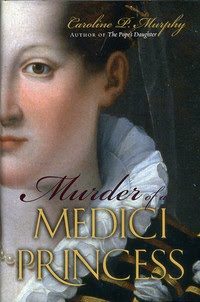
Novels in Florence #30: Murder of a Medici Princess


In Murder of a Medici Princess, Caroline Murphy illuminates the brilliant life and tragic death of Isabella de Medici, one of the brightest stars in the dazzling world of Renaissance Italy, the daughter of Duke Cosimo I, ruler of Florence and Tuscany.
Murphy is a superb storyteller, and her fast-paced narrative captures the intrigue, the scandal, the romantic affairs, and the violence that were commonplace in the Florentine court. She brings to life an extraordinary woman, fluent in five languages, a free-spirited patron of the arts, a daredevil, a practical joker, and a passionate lover. Isabella, in fact, conducted numerous affairs, including a ten-year relationship with the cousin of her violent and possessive husband. Her permissive lifestyle, however, came to an end upon the death of her father, who was succeeded by her disapproving older brother Francesco. Considering Isabella's ways to be licentious and a disgrace upon the family, he permitted her increasingly enraged husband to murder her in a remote Medici villa. To tell this dramatic story, Murphy draws on a vast trove of newly discovered and unpublished documents, ranging from Isabella's own letters, to the loose-tongued dispatches of ambassadors to Florence, to contemporary descriptions of the opulent parties and balls, salons and hunts in which Isabella and her associates participated. Murphy resurrects the exciting atmosphere of Renaissance Florence, weaving Isabella's beloved city into her story, evoking the intellectual and artistic community that thrived during her time. Palaces and gardens in the city become places of creativity and intrigue, sites of seduction, and grounds for betrayal.
Here then is a narrative of compelling and epic proportions, magnificent and alluring, decadent and ultimately tragic. (from jacket notes)
Murder of a Medici Princess, Caroline P. Murphy, Oxford University Press, 2009

Jan 14, 2011

Novels in Florence #23: Florence: A Delicate Case


David Leavitt brings the wonders and mysteries of Florence alive, illuminating why it is, and always has been, one of the most popular tourist destinations in the world.
The third in the critically-acclaimed Writer and the City Series-in which some of the world's finest novelists reveal the secrets of the cities they know best-Florence is a lively account of expatriate life in the 'city of the lily'.
Why has Florence always drawn so many English and American visitors? (At the turn of the century, the Anglo-American population numbered more than thirty thousand.) Why have men and women fleeing sex scandals traditionally settled here? What is it about Florence that has made it so fascinating-and so repellent-to artists and writers over the years?
Moving fleetly between present and past and exploring characters both real and fictional, Leavitt's narrative limns the history of the foreign colony from its origins in the middle of the nineteenth century until its demise under Mussolini, and considers the appeal of Florence to figures as diverse as Tchaikovsky, E.M. Forster, Ronald Firbank, and Mary McCarthy.
Lesser-known episodes in Florentine history-the moving of Michelangelo's David, and the construction of temporary bridges by black American soldiers in the wake of the Second World War-are contrasted with images of Florence today (its vast pizza parlors and tourist culture).
Leavitt also examines the city's portrayal in such novels and films as A Room with a View, The Portrait of a Lady and Tea with Mussolini. (from jacket notes - Bloomsbury Publishing)
Florence: A Delicate Case, David Leavitt, Bloomsbury Publishing, 2002

Jan 5, 2011

Novels in Florence #2: The Agony and The Ecstasy


Celebrating the 500th anniversary of Michelangelo's David, New American Library releases a special edition of Irving Stone's classic biographical novel-in which both the artist and the man are brought to life in full. A masterpiece in its own right, this novel offers a compelling portrait of Michelangelo's dangerous, impassioned loves, and the God-driven fury from which he wrested the greatest art the world has ever known.
Irving Stone was born in San Francisco on July 14, 1903. He wrote several books in a genre that he coined the "biographical novel," which recounted the lives of well-known historical figures. In these novels, Stone interspersed biography with fictional narrative on the psychology and private lives of his subjects. He also wrote biographies of Clarence Darrow and Earl Warren, and short biographies of men who lost presidential elections. He died on August 26, 1989. (from amazon.com)
The Agony and The Ecstasy, Irving Stone, New American Library, 2004